From our 2012 Christmas Sale Invitation
Sam Uhlick - Middle of the Road Potter
Last year I was honoured to be the only Canadian participant in a show called TableSpace at the Fosdick Nelson Gallery in Alfred, NY. The show curator and professor, Linda Sikora, asked me to write a statement of "how the work moves and rests in the culture after it leaves your studio and perhaps your thoughts about how the work contributes to the contemporary material culture/world". This was pretty deep for me and the following statement was the best I could come up with. I wrote part of it for a show called Elements of the Earth, Alberta Clay, in 1984.
"I feel that although form, function, pattern and colour are all important in pottery, it is the warmth and spirit that can only be experienced through handling and use which are most important. Good pottery must have a liveliness and interest which goes beyond technical mastery."
Much of the pottery I've made over the 40+ years has been used, chipped and cracked, broken and discarded. I've made most of the pottery and tile with stoneware clay and it's a fact that, when broken, it is as good as gravel on the driveway. A few pots have gone to museum collections, but that was never my intention or expectation. I am touched when I see my old pots that are still treasured in the homes of friends and collectors. Some of those pots weren't that wonderful and yet they are fondly used by their owners (and they still look okay to me). I haven't tried to evoke emotion with my pottery, but my pots are at their best when they engender it.
It isn't always an easy life as a potter (physically it can be hard on us over time). What is essential is that we find pleasure and satisfaction in our life's work and I have. In the material world my pots lie somewhere between gravel and museum. Yet there is a comfortable middle ground for the kind of functional pottery that I make, a bit hit or miss and never perfect. In spite of its flaws, I like my own pottery best.
Michael Cardew said in his book, Pioneer Pottery, "The training of a potter is a process limited only by the span of his life." Another of my favourite quotes is from William Blake's proverbs of hell, "If the fool would persist in his folly he would become wise." I think Cardew's statement is true, but I'm afraid I can't count on Blake's.
Sam Uhlick
From our 2012 Spring Sale Invitation
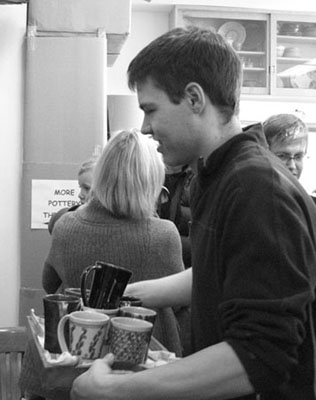
Martin Samuel Uhlick
Our world has turned upside down since our beloved son, Martin, died on January 29, 2012. He is very, very sadly missed by his family and friends. His memorial service was on February 4th and many of you were there. There were 400 people in attendance and we have been heartened by your kind words and thoughts. Sam's tribute to Martin can be read at www.uhlick.com/martin.
Martin took his own life and although he said in his letter to us that he had been depressed for years, he never told us of his depression and neither did his friends know of it. We learned later that he had been taking the stop smoking drug Champix and we think that this might have contributed to his final depression. One of the adverse effects of the drug is suicide.
We hope that anyone who has feelings of depression will seek help, as we sorely wish that Martin had.
Sam & Antonia
From our 2011 Christmas Sale Invitation
Uhlick Pottery on Facebook
We almost always like to have customers come to our workshop between sales (the exception is the month or so just before a sale). Making pottery is a quiet and sometimes solitary occupation. It is nice to see a friendly face and it is a more relaxed way to have a visit than at one of our sales. Almost everyone who comes through the door to our workshop for the first time, when we are actually making pots, stops and says with horror "What happened?" At its best our workshop has a ragged, jumbly, disordered and dusty look about it; at its worst it looks like a junk bomb went off. That pots that are being made are organized but everything else is piled up with a layer of dust on top! You may have thought, after coming to a sale, that I was a nice tidy person. This is one of the reasons for our new Uhlick Pottery & Tile facebook page (thanks to our daughter Claire for this 'innovation'). I have been posting a photograph nearly every day, to show some of the mess, but mostly to show the process of making pots and the progress from our normal disaster to the clean floor and organization of our sale. At this point, there are photos of throwing, trimming, slipping, decorating pottery, and of a young bull moose that was moseying around our pond. By the time you receive this there will be photos of our firings and finished pots too. The best thing is that you don't have to be on Facebook to see this page. You can google us, or go to
Uhlick-Pottery-Tile to see our worst. These daily postings will be for this month only, with some occasional postings later. We hope that you will still want to come to our sale after seeing the truth revealed.
Sam
November 21, 2011
From our 2011 Spring Sale Invitation
Ilya Oratovsky - Hand Weaver
For the last 40 years I have loved handmade pottery and other tools and objects that are elegant combinations of function and beauty. Our world would be a colder place if we didn't have anything made by hand.
I think tht handmade pottery and furniture, hand knit sweaters, quilting and hand weaving have different vibrations than machine made objects. For me, there is a warm glow from these objects, almost like the glow from healthy skin. Other people see or sense this too.
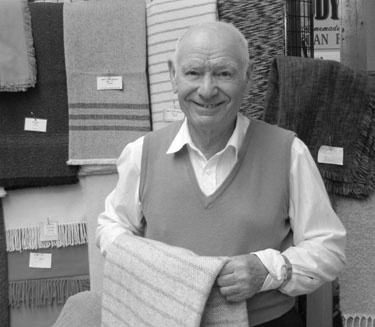
I was honoured by the Alberta Craft Council this winter to be nominated for a lifetimne achievement award. I would like to recommend someone who, at 80 years of age, truly is a lifetime craftsman and deserves much more recognition. The hand weaver Ilya Oratovsky, who sells his work at the Strathcona Market, is often overlooked because his craftmanship is so good that people mistake his work for machine weaving. Antonia and I visited Ilya and his wife Maria, who is also a weaver, at their home. We saw in his simple workshop, the looms and warping mill that he built himself. These are not the beautiful looms that are pieces of furniture, but functional tools for a man who knows exactly what he needs. Ilya and Maria were trained in the Ukraine and he designs and weaves beautiful wool, and wool and alpaca blankets. Japan is a country that has had a long tradition of handcrafts and a respect for the craftspeople that make them. If Ilya were Japanese he would be respected and nationally recognized for his skill and dedication to his craft, and his blankets would cost much more than they do here.If anyone has not had a chance to see Ilya's traditional blankets or to buy one (or a dozen like we have), please look for him at the Strathcona Market. You can find his table in the second aisle from the east and about 100 feet north of the main entrance. His work is also available at one of the only stores in Edmonton where nothing is made in China, the Alberta Craft Council Gallery at 10186-106 Street.
If handmade objects are the warm skin of our interactions with life, Ilya is one of the people who can keep us warm in two ways.
From our 2010 Christmas Sale Invitation
 Photographer: Mike Lipset
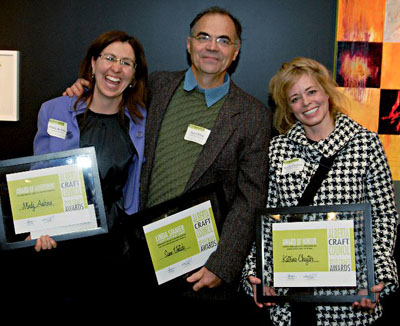
This October I received the Linda Stanier & Family Memorial Award for 2010. This award was presented in Calgary along with the Award of Honour, presented to Katrina Chaytor and the Award of Achievement, received by Mindy Andrews. You can find out more about the awards and the recipients at http://www.albertacraft.ab.ca/index.htm.
This is Linda Stanier's letter of nomination:
I first became aware of Sam Uhlick while studying Clay at the Nova Scotia College of Art and Design in the early 90's. Walter Ostrom, head of the ceramics program, declared one day that Sam Uhlick was the best potter in Canada. Specifically I recall that Walter felt Sam met the daily task of making a living as a studio potter with superb craftmanship and integrity of vision.
I was eager to experience Sam's work after that and quickly acquired my own piece of his after moving to Alberta a few years later. As an aspiring studio potter, Uhlick's work was an inspiration to me through its diversity of form, clarity of execution and diligent abundance. One often learns through example and with Uhlick this is particularly neceswsary as he is a shy and retiring figure, leaving the limelight to academics and showmen. But step into any major pottery venue in the last 20 years across Canada and there was work of Uhlick's to see, fondle and purchase. Oriental inspirations are evident in the simple cobalt/chrome colour combinations he uses. His sense of patterning is enlivened by the spontaneity of freehand brushstrokes and sgraffito. There is energy in his mark making. Energy of that kind is found in work that has been done many times and is the ultimate challenge for the studio potter: to present cliche's so clearly they appear original.
He has had the respect and attention of the Canadian ceramics community and is collected across our country and around the world. No mean feat for a potter working from Ardrossan, Alberta. It was, however, the quote included in the Clay 2010 catalogue that caused me to leap from my chair and fire him an email of acclaim, "If all ceramics were divided into two groups, there would be those objects that are dusted and those pots that are washed. Almost all of mine would end up in the kitchen sink." Such humility in the face of our celebrity age is truly laudable and evidence of an understanding of the true worth of hand made pottery: that it will live on as a testament to a moment of creative energy separate from ego through the continued celebration of daily use.
Sam Uhlick is a professional craftsman of tremendous creative and personal integrity and I feel it is this above all that qualifies him for this award in the name of Linda Stanier.
by Diane Sullivan
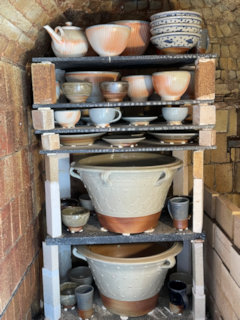
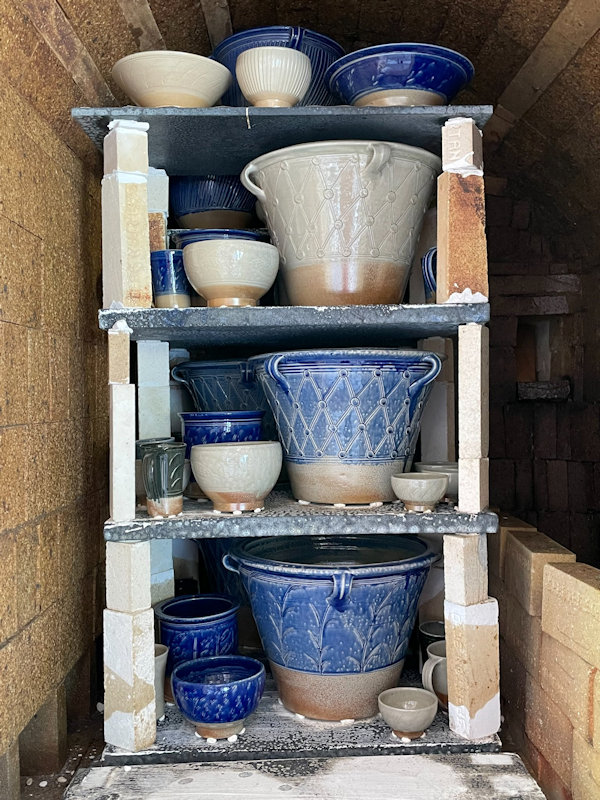
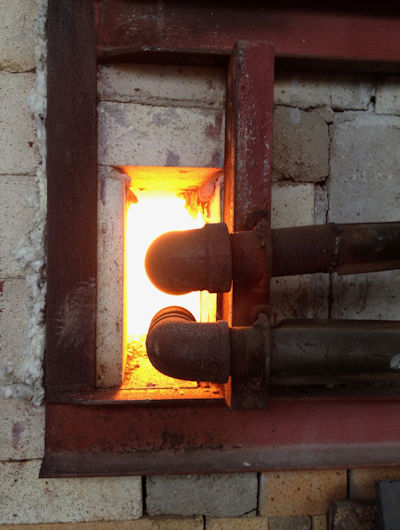
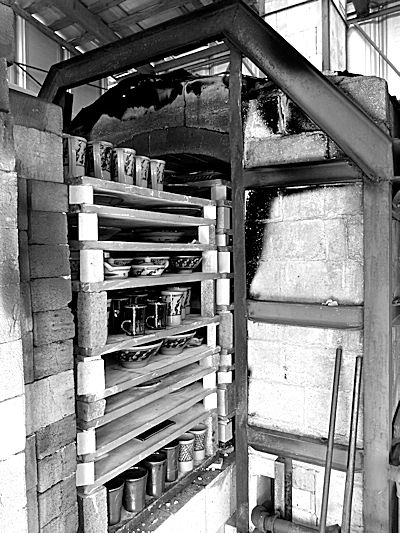
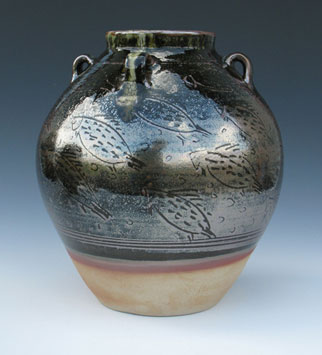 From the first firing in May 2010
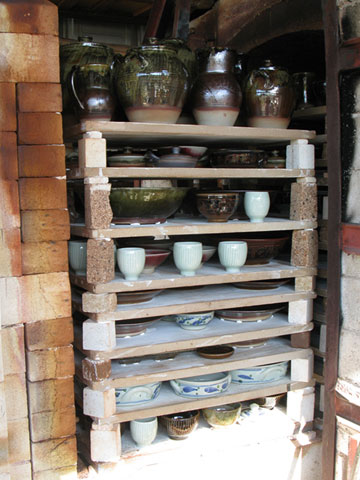
From our 2010 Spring Sale Invitation
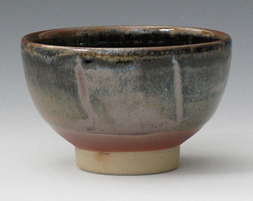
Pottery Vibrations
Someone, about thirty years ago (I think in Ceramics Monthly magazine), compared the throwing marks on an ancient platter and the grooves on a record. (Younger readers should look up record/record player in Wikipedia). The idea they had was: wouldn't it be interesting if some future scientist could translate those throwing marks into sounds from the ancient potter's workshop? The earliest possible sound recordings! Thirty years ago this was an amusing and whimsical notion. These days perhaps it isn't so impossible. We hear about the ability of science to measure isotopes in a migratory bird's feather that will show where that bird had moulted. This seems amazing to me, so perhaps the possibility that potters might be inadvertently making sound recordings is not so laughable. Considering how quickly a pot may be thrown though, one couldn't expect to hear much more than fragments of a CBC radio program, or a dog's bark, from one of my pots. Possible sound recordings aside, I think that we potters do transmit vibrations to our work (for better or worse), with every touch of a finger or stroke of a brush. These vibrations may be too subtle for our modern scientific instruments to detect, but people who are sensitive to handmade objects can feel them none-the-less.
From our 2009 Christmas Sale Invitation
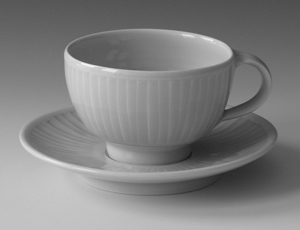
Cups and Saucers: "Many a slip..."
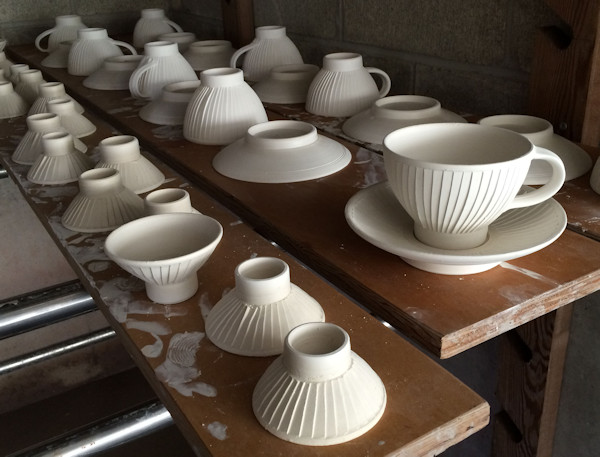
It has always been music to our ears when someone tells us they enjoy using our pottery. Functional pottery is tactile and needs to be used to be fully appreciated. But handmade pottery is relatively expensive; some shapes more expensive than others, and not always for obvious reasons. An example of this would be teacups and saucers, more appropriately called cups and saucers. Breakfast cups and saucers are used for coffee these days, or a comforting bowl of chicken soup. Saucer'd cups have been made for a thousand years; some beautiful examples from Chinese and Korean history are wine and tea cups with saucers. The western world didn't just get tea from China; we got "china" from China (now of course we get everything from China). A couple of hundred years ago, English teacups and saucers were just for the upper class. My own mother, working class and old fashioned (she was born in 1908), would have afternoon tea parties with her best bone china teacups and saucers. For most of us, slopping a dribble of tea isn't a problem, but if one is dressed up for afternoon tea, one can see the usefulness of a saucer. But why are they so danged expensive? In fact, we try to keep the price lower than it might be, just so we can sell them. Both the cup and saucer take more time to make than an ordinary mug. In addition, they are fraught with difficulty. The foot of the cup has to fit into the indentation of the saucer. The both have to come out of the kiln in good shape too. If just one of them is a "second" the set becomes a "second" or worse. There definitely is, for a potter at least, many a slip twixt the cup and the lip.
From our 2009 Spring Sale Invitation:
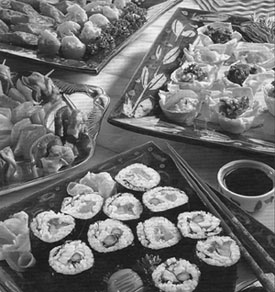
Pottery and Food
Recently on THE AGE OF PERSUASION (a really good CBC radio program about, of all things, advertising), Terry O'Reilly was told by a client that "we don't sell 3/4 inch drill bits, we sell 3/4 inch holes". You could say the same thing about purely functional commercial pottery; that it is the space which it contains that is important. I suppose as functional potters, we are, in fact, selling a better, we hope much better, "hole". Our pottery is meant to be used; the tactile appreciation of it is only possible when it us used.
Pottery and food have been connected for over 6,000 years of human history. A bowl is a symbol for food and life itself. Maybe because of this, pottery has been anthropomorphized; we talk about feet, bellies and lips of pottery, and although pots can last 10,000 years, they are fragile.
Commercial pottery is inexpensive and these days it might be hard for some to justify the cost of handmade products. And yet...there is, or can be, an emotional response to our pottery. We feel regret and even sadness when a really special pot breaks. Other people do too. Handmade pottery has warmth adn vibration that isn't present in commercial pottery; even the most skillfully made handmade pots have imperfections that show the process of making. There is an inherent depth to hand applied glaze, and a lustre in glaze and decoration that enhances food. We have heard from many people that "food tastes better in one of your pots". Not just pottery, but other handmade items, have this warmth and their daily use enhances our lives.
From our 2008 Christmas Sale Invitation:
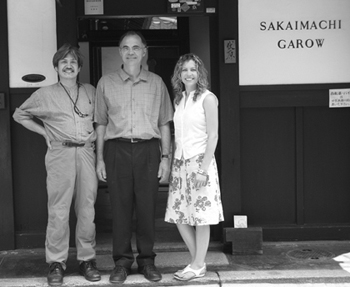
This has been an interesting and, at times, difficult year. I had my 55th birthday and up until this year I would have said that I have been aging gracefully; the wrinkles on my face were nicely catching up with the worry lines on my forehead. I'm afraid tht trend has faltered a bit in 2008. The shows at the Alberta Craft Council and in Kyoto were for the most part fun. As I said in my "speech" at the opening of the ACC show, "This show is a stage in this potter's life, and it's given me a chance to think about what I know and where I am". I have been comfortable with my pots and slow progress over the years, but I was grateful for this chance and I didn't want to disappoint my friends. I tried some new ideas with very mixed success; no one wants a chimney pot, but they were fun to make. They were also too heavy to take to Kyoto where they would have been even more baffling for the Japanese. The show at the Sakaimachi Gallery was a success and the trip to Japan with our daughter, Claire, was wonderful. Claire is an artist (www.clairelouiseuhlick.com) and is interested in architecture and art history as well. She was a lot of help in setting up the show and a pleasure to travel with. We stayed with my old friend, Mayao Umesao, who is a potter, and his wife, near Kyoto, for part of our trip. Mayao was the first person I met the summer of 1971, when I attended the Banff School of Fine Arts. It has been about 10 years since we last met si it was especially heartening to see him and his family again.
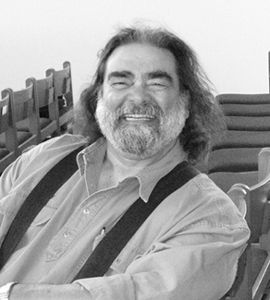
There were some losses in this past year too. The photo at the bottom of this section is of my friend Geoff Hughes. You might have seen him and talked to him at our sales over the years. You can read my eulogy for him at www.uhlick.com/GeoffHughes. He is sadly missed by me and many more friends.
Finally, I should say that I have never felt more the blessings of my wife, Antonia, my family and friends (old and new) than I have this year.
Best wishes,
Sam Uhlick
From our 2008 Spring Sale Invitation:

Sampler Poem Plate
I read this lovely poem in January and used it for not only this plate, but also for the title of the show "Alberta is My Home". I think you will agree that, in the case of this commemorative plate, it would be much more poignant if I were already dead, but all potters and artists hope that their work does "stand the test of time".
Samplers were examples of cross-stitching or embroidery done by young women during the 18th and early 19th centuries.
Elisabeth Crandall is my name
And America is my nation
Providence is my home
And Christ is my salvation.
When I am dead and in my grave
And all my bones are rotten,
If this you see
Remember me
When I am quite forgotten.
1845
From Wobegon Boy by Garrison Keeler.
From our 2007 Christmas Sale Invitation:
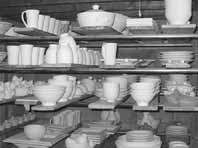
For all of our pottery friends and customers who haven't visited our workshop between sales, it is hard to describe the apparent disorder that you's see. Pottery in stacks, higher stacks if they have been bisque fired, smaller stacks if they are drying or waiting to be bisqued, along with pots on boards in the damp room waiting to be trimmed or handled. As well, there are the other projects that seem to happen simultaneously - repairing or making tools, woodworking or welding. this is our normal workshop and we seem to get a surprising amount of work done. Not, though, in a very scientific or business-like way. Someone came out to the workshop when we were in full production mode and exclaimed "What happened?!" Even the UPS driver once looked at the 'mess' and commented that it was a work in progress. In spite of this, we welcome visitors between sale.
I always use the summer months for mixing the clay, building equipment and working on the workshop/house itself, which is still not finished. This summer I prepared a new blunger for clay mixing to replace the old one (which is just about worn out) and finished two sides of our kiln shed. The stages of a cycle of pot making starts with mixing the clay (we've bought 137 tons of raw clay in the last 29 years), pugging (this is done in a pugmill, a machine that I built 25 years ago for mixing and de-airing plastic clay) and throwing clay, trimming and handling pots, fettling and bisque firing, glazing and decorating, firing and fettling the pots again, cleaning up and preparing for a sale. Easy to list the steps, but each step takes time and skill to complete. It's almost always been fun, though, for all of these years. There is a little bit of magic along with the art and science in making a piece of pottery.
From our 2006 Christmas Sale Invitation:
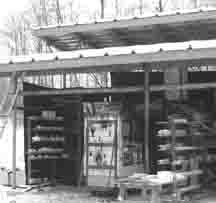
Kiln Shed
When we first moved to the country, at the end of the summer of 1995, we moved to a house and workshop that weren't finished. There was painting, setting up the workshop, and a hundred other things to do. We didn't start to build the kiln until October. But we worked like mad and managed to make enough pottery for two firings in our new kiln. The firings were okay and we had some umexpected blue pots that were much admired by some, but never repeated. The doors weren't even hung in our house when we had our first sale that December. I remember that the weather was cold during the sale, but lots of people came and it was very heart-warming for us.
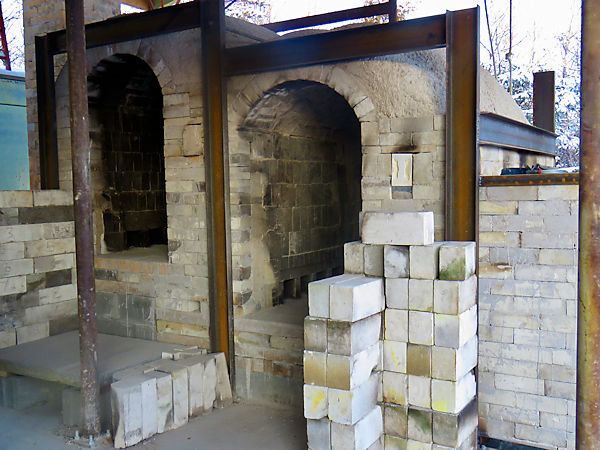
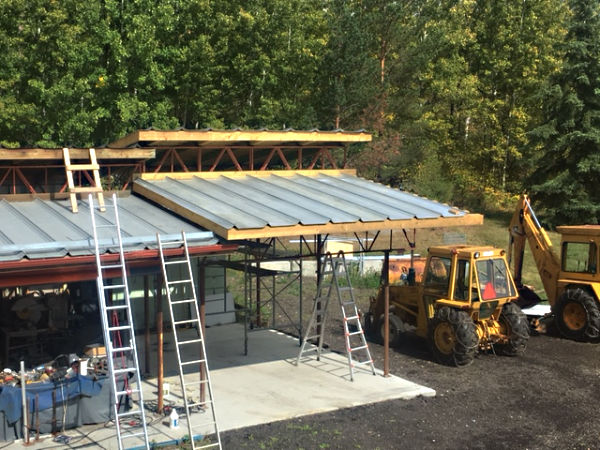
Although a kiln shed was in the plans, there were always more important projects (doors, bathrooms, stairs). This year we do have a kiln shed. Started in September, the last roofing was put on the day before it snowed. The trusses came from a demolition company, the standing seam roofing from our friend, Paul Ryan (Ryan Scrap and Industries) and the posts were piping from the inside of the oil field shacks that we got from O'Hanlon Paving. Along with 30 lbs. of welding rod, these materials were recycled to become our new kiln shed.
There is a business philosophy that says that companies should stick to their core product for greatest efficiency. Yet it has always been a pleasure for me to build the equipment for our workshop; to work with stone and wood and steel, as well as make the pottery, clay and glazes. A good business philosophy isn't alwasy a good philosophy for life.
From our 2006 Spring Sale Invitation:


Time Flies...
An old joke that we tell in our family is the one that goes: Time flies like an arrow; fruit flies like a banana. We all know that the older we get the faster the arrow flies and we seem to be feeling it, especially this spring (of course fruit flies prefer an older banana). Some of you will remember the Christmas Sale at our old workshop in Bonnie Doon, when Anna was a new baby, mostly sleeping in her basket while we packed pottery. Over the past 25 years, Antonia and I have gone from having no children (that period didn't last very long!) to four children too small to help. Now we are blessed with four adults who are so helpful that it would be hard to do without them. We only have two living at home now, although they will all be helping at this sale.
Nicole, our youngest, is graduating from grade 12 this spring and will be leaving us for a Canada World Youth exchange in September. CWY is an exchange program whose mission is "to increase the ability of people, and especially youth, to participate actively in the development of just, harmonious and sustainable societies". The participants from both countries will be involved in community work projects, learn a new language and become better citizens of the world. You can find out more at www.cwy-jcm.org. You might remember that Anna was on a CWY exchange three years ago. If any of you are interested in this program, please talk to Nicole or Anna. One of the participants' responsibilities prior to leaving on the exchange is to do some fundraising. I'm sure that Nicole would welcome any donation to Canada World Youth.
From our 2005 Christmas Sale Invitation:
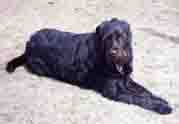
Mishka
When we moved to the country in 1995, one of the nicest additions to our family was our dog Mishka. She became our friend and "Greeter". She was here for every Sale and was a good dog. When she was young she used to chase the deer and coyotes; we remember her as a black speck chasing a bounding deer. We were always afraid that she would catch the deer or that the coyotes would catch her. She wasn't a good dog at first. She was rude and sometimes aggressive; she could be snappish when people touched her food and when greeting people she would sniff in embarrassing places. But she was fun from the start, in a maddening sort of way, and we loved her. She failed her first obedience class and, worse, she chased cows, which in this part of the country, can mean a death sentence. But she lived, and became a black and beautiful part of our landscape. Wherever we walked, she was with us, always in front of us when she was young, but lately more often behind us. She was a very good dog. Her job was to watch, to bark, and to never, never bite. Always a part of our Sales, she will be missed this year. When she was young she would sometimes take a child's cookie, but as she grew older she learned not to do this.
It's been several years now since she'd chased any deer. She had grown from her youth, to middle age, to aged so quickly. She died on November 8th and we miss her. There is a black hole in our landscape, the ghost of a good dog.
From our 2005 Spring Sale Invitation:
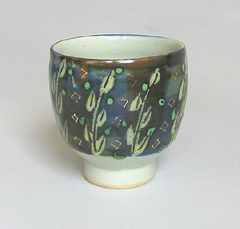
Yunomi
Yunomis are Japanese teacups and, like our teacups and mugs, are made in many sizes, from the size of sake cups to the larger sushi shop size, which is the size that I make. I've often been asked about these cups, sometimes because of the price (they cost more), and because of the spelling of the word.
Drinking cups are probably the most 'intimate' pots that we make. They are the only pots, in western culture at least, that we put to our lips. (There are exceptions of course: soup cups, coffee bowls in France and soup bowls in the Orient). Yunomis are more tactile than most cups. Mugs have handles and are fast. Yunomis don't have handles, so they need to be handled with more care. They take more time to make and decorate and they take more time to use: yunomis are slow pots in more than one way.
I think that this intimate connections we have with cups contributes to the love some of us have for pottery. Nursing a warm cup, combined with an addiction to tea or coffee is a potent sensory experience. I love Java, but especially in my favourite cup!
From our 2004 Christmas Sale Invitation:
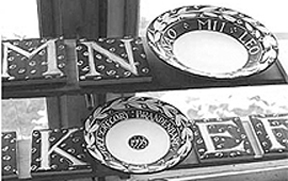
Miscellany
Commemorative plates and bowls have been made (probably) since there were literate potters. There are many examples of poetry and religious quotations on Persian pottery from the 10th century. Wedding plates and betrothal plates were made in England and Europe since the 16th century.
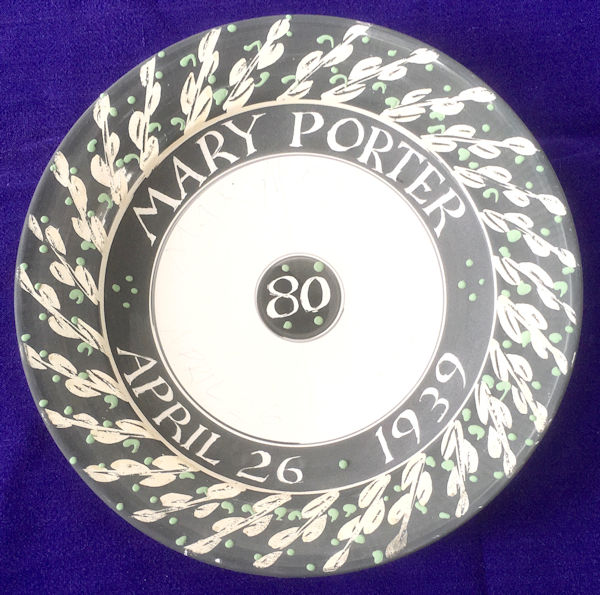
The first commemorative pots that I made were at Wenford Bridge Pottery in Cornwall in 1978 for the 25th anniversary of the Coronation of Queen Elizabeth II. I made dozens of mugs and some beer steins that had EII R, a crown and the dates 1953 and 1978 scratched into the slip. Since then I have made thousands of commemorative mugs, albarellos, wedding plates, birth plates and bowls. I have made letter and number tiles and trivets as well (I'd love to do a complete tile alphabet for someone's nursery). The most difficult and memorable commemorative plate that I have made was for Beryl Hedley-Smith's 80th birthday, which included her name and the names of her seven children.
In 1975, in Jean and Henry Ward's collection, I saw my first harvest jug, inscribed with the following poem:
Ode to the Farmer
May the wealthy and Great, live in Splendour and State
I envy them not I declare it!
I eat my own Ham, my Chickens and Lamb,
I shear my own fleece and I wear it,
I have lawns, I have bow'rs
I have trees, I have flow'rs
The lark is my morning Alarmer,
So Jolly Boys now, here's God Speed the Plough,
Long Life and Good Health to the Farmer.
From our 2003 Christmas Sale Invitation:
Slipware
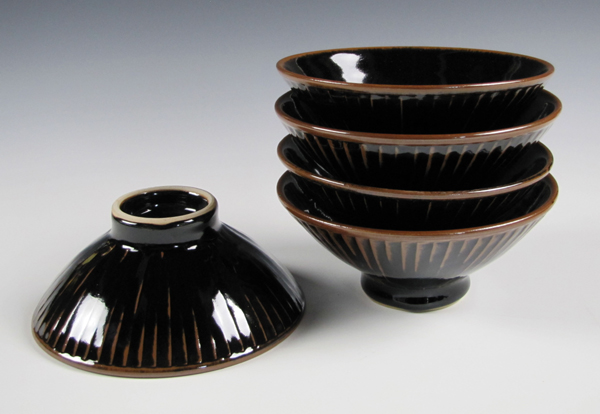
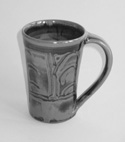
One of the glaze/decoration combinations that Sam has used for over 26 years is shown in the photo above (we call the pattern on this mug "eyebrow"). Potters sometimes mistake this technique for an iron glaze called tenmoku. Actually, it is a combination of an iron slip under a translucent glaze. Leather hard pots are dipped into the slip (a mixture of iron oxide and liquid clay) and then decorated by combing, while it is still liquid or soft. This method of decoration is called slipware. The technique was first used in China (like most things in ceramic history) and can be seen on pots made earlier that the 10th century. Michael Cardew (with whom Sam apprenticed in 1977) made slipped earthenware pottery at Winchcombe, and later used the technique on stoneware at Wenford Bridge Pottery. Sam learned to decorate with this technique at Wenford Bridge and has been using it ever since.
It is interesting to note, in case anyone collects old English slipware, that those early jugs and pots were glazed with a raw lead glaze, and should not be used. All of our stoneware pottery is fired to 2300 degrees F. (1280 degrees C.) and lead is never used at these temperatures.
From our 2003 Spring Sale Invitation:
Copper Red
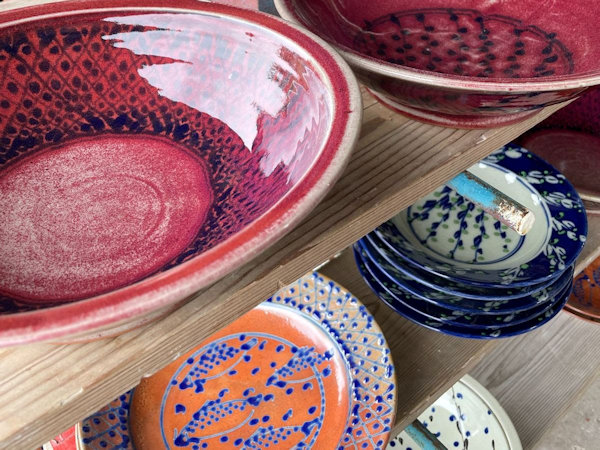
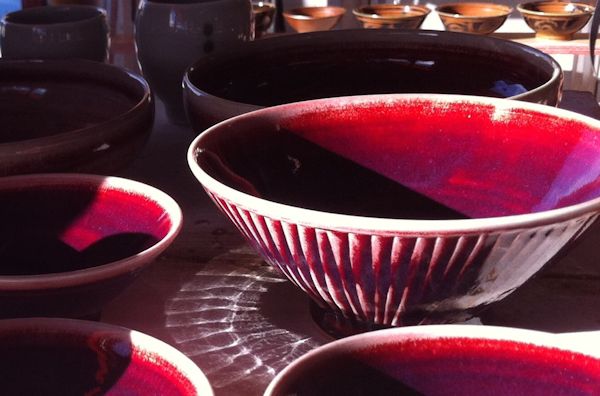
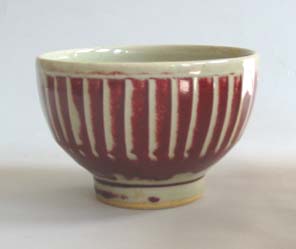
The colour photo of the fluted bowl above has a glaze known as copper red or sang-de-boeuf. This glaze is another famous Chinese invention and is one that, until recently, I hadn't really liked. It can be too showy, so bright that it looks like paint. Although copper is a potent colouring oxide (there is only 1/4 percent in our red), the colour can be difficult to achieve, tempermental and fugitive. The atmosphere in the kiln, the speed of cooling, and the thickness of the glaze are all factors affecting it. When this glaze is imperfectly fired, you can find the full range of colour, from the pale green of the base glaze to red or plum. I find this contrast, although considered a defect by some, much more attractive.
From our 2002 Christmas Sale Invitation:
Celadon
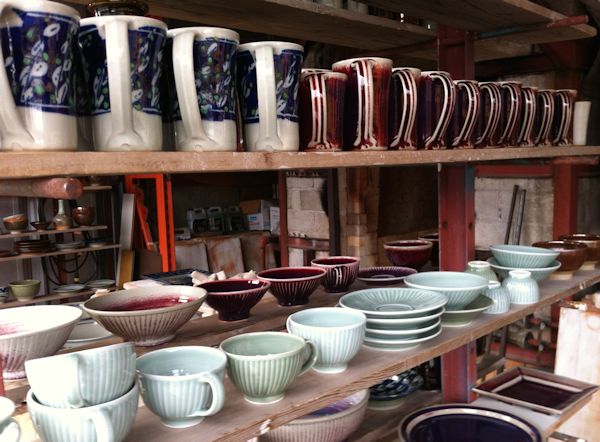
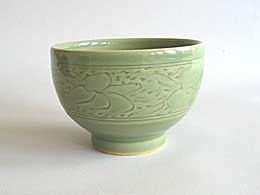
The bowl in the photo above has a green glaze known as celadon. Celadon glazes, which range in colour from pale blue-green to dark olive green, are probably the oldest feldspathic glazes. The green colour comes from iron oxide suspended in the glaze melt. In early glazes this probably came from the stone or ash that was used to make the glaze. One of our celadons, made from the same granite tha we used for part of our stairs, developed a very nice pale green without any additional iron. According to Hetherington in Chinese Ceramic Glazes, the word celadon "derived from Saladin, Sultan of Egypt, who sent forty pieces of the ware to Nur-ed-din, Sultan of Damascus in 1171. Another derivation is from the shepherd Celadon, a character in a seventeenth-century romance called L'Astree, written by Honore d'Urfe. The shepherd was garbed in a grey-green coat of a distinctive tone"
Although today the celadon is not our most popular glaze, it has always been a favourite among potters, and at least one special friend.
|
|